













(This story originally appeared in The Epoch Times)
By Jeff Louderback
On a 60-acre homestead in the Appalachian foothills of southern Ohio, Tara Dodrill homeschools her 10-year-old grandson, Cole. For her family, homeschooling and homesteading are connected, and her experience inspired her to start an event that teaches hands-on skills for children interested in both.
The Heritage Explorers Fest and History Fair, which took place on Oct. 16, is an outgrowth of the Heritage Skills USA Homesteading Summit, formerly known as the Old School Survival Boot Camp, held every summer in Ohio.
The summit attracts people from around the country to learn everything from butchering, canning, foraging, and herbalism to emergency medicine techniques, food preservation, blacksmithing, and beekeeping, among other skills.
“We’ve lost our way as a society because it is less common to know how to provide your own resources than it was even 75 or 100 years ago,” Dodrill told The Epoch Times.
“The summit is a hands-on, interactive event. You learn better from hands-on experiences, and the more you do something, the more comfortable you get. That applies to children, too.”
Tara Dodrill, who hosts the summit with her husband, Bob Dodrill, said they offered a few classes for children during the boot camp’s first year in 2021. There was a bigger turnout than expected, which inspired her to start a homeschool co-op and develop a homeschool curriculum focused on homesteading. This is how Heritage Explorers, which includes the co-op and a membership for curriculum access and events, was born.
“Homeschooling and homesteading go hand in hand,“ Tara Dodrill said. ”We found that many homeschoolers and homeschool parents attended that first boot camp, and a lot of homesteaders were interested in homeschooling their kids.
“It makes sense why there is a connection between homeschooling and homesteading. Both involve independence and self-reliance.”
Parents have cited reasons that include concerns about curriculum and safety in the classrooms and a desire for a more tailored education than traditional school offers.
Joy Hysell made the hour-long drive to the Heritage Explorers Fest with her 8-year-old son, Carter, whom she has homeschooled since he was 4.
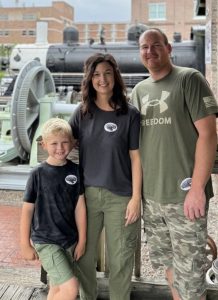
Hysell admitted that she did not always appreciate the benefits of homeschooling. Carter is an only child, and Hysell thought that he would need the socialization that would come from being around other children.
Before giving birth to Carter, Hysell taught elementary school in a public school system in southern Ohio for five years.
She left the profession to become a stay-at-home mother. Later, she returned to the classroom as a preschool teacher.
That stint was short-lived.
“The public school environment had changed so much in just a few years,“ Hysell said. ”There was fighting and bullying, and there was a curriculum with critical race theory. Teachers tried to get it stopped, but it remained. I didn’t want [Carter] to be part of what it had become, so we went back to homeschooling.
“I had 26 first graders my first year of teaching. I rarely got one-on-one time with students the entire time I taught.”
Hysell said parents know their kids better than anyone else.
“So many kids in a classroom are at different levels and are getting a one-size-fits-all education because teachers don’t have the time for personal instruction,” Hysell said. “The one-on-one attention is more effective, I think, and the schedule allows you to give your kids a chance to explore their interests firsthand.”
The Hysells live near the Ohio River. Carter is fond of barges and trains. When he completes classwork in core subjects, Carter accompanies his mother on adventures to train tracks and the river to watch the barges drift along.
When Carter becomes old enough, he wants to work on a barge and eventually ascend to captain a vessel, according to Hysell.
“He knows the schedules of all the barges and trains, so we spend a lot of time watching both,” Hysell said with a laugh, noting that Carter even has a YouTube channel dedicated to his two main interests. “If he had to sit in a building all day at a traditional school, he wouldn’t have as much of a chance to learn all he is learning.”
Hysell said she only learned about Heritage Explorers recently.
“Being around other homeschooled children of different ages is good for him,“ Hysell said, noting that she and Carter have joined Tara Dodrill’s co-op and plan to incorporate some of the curriculum. ”On the drive home, he kept talking about how much fun he had because he got to see so many other kids showing their interests. He left feeling inspired.”
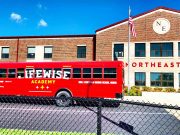
Varun Bhatia is director of the Acton Academy, a micro school in suburban Columbus. Children are enrolled as homeschoolers, and they meet Monday through Friday from 8:30 a.m. to 3 p.m. Teachers are called guides, and the school has a “learning-led environment where children move at their own pace,” Bhatia said.
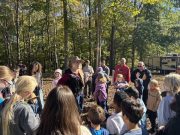
A group of 30-plus students and their parents accompanied Bhatia to the Heritage Explorers Fest. They are involved in a seven-week “homesteading quest” program, so the event allowed the children to practice some of what they have learned.
“This is a perfect combination for us to come out here and then learn about it from people who live the lifestyle,” Bhatia said. “Experiential learning is what differentiates a homeschool environment and the standard approach of a public school. Children tend to absorb more knowledge and cultivate more interests.”
Bhatia mentioned Melissa Renee, a homesteader who has homeschooled her children for 25 years, as an example. Bhatia and many of his school’s students took part in Renee’s foraging class, which involved walking through the forest and identifying plants and trees.
“It’s easier to learn about plants by going out in the woods with someone who knows the subject than just reading about it in a book,” Bhatia said.
Renee, who moved from her native Mississippi to southern Ohio in 2019, is a holistic health practitioner who lives on a two-acre homestead located next to Amish farmers. Her two oldest children were homeschooled. They are now grown, and she still homeschools her two youngest sons, who are 10 and 15.
At the Heritage Explorers Fest, she also taught a canning forum and a class in which children dissected crawfish.
“Homeschooling gives your children more time to explore their own interests,“ Renee said. ”At events like Heritage Explorers, you get hands-on opportunities to have new experiences and see if they are good at something and like something. Perhaps it will lead to a career path.”
Her oldest son is 21. She started homeschooling him when he was in elementary school. He attended theater and video production classes and workshops, eventually volunteered at a church as an audio engineer, and started his own video production and photography business before he graduated from high school.
Renee has a 15-year-old son who took coding classes for children offered by MIT when he was 7. That sparked a career interest that led him to co-create a platform reminiscent of YouTube.
“I didn’t teach any of those skills,“ Renee said. ”He developed an interest and explored it, and now it is something he wants to do for a career.”
Her son develops and manages websites, codes, and creates apps. Two apps are approved for pre-development for the Apple Store, she said.
“Field trips, hikes, festivals, they all complement what is taught in textbooks,“ Renee said. ”Education should not be about reciting facts for standardized tests. True intelligence is learning for life, not learning for graduation.
“There is more opportunity for homeschoolers now than when I started with my oldest child [who is 26]. There used to be economic and time barriers, but now colleges and universities, museums, state governments, and libraries are among other institutions that offer programs for specialized interests.”
At the Heritage Explorers event, children participated in classes on skills ranging from building fires, foraging, and canning to candle-making, needlepoint, and water filter-making.
Three families, including the Hysells, joined the co-op, which meets twice per month and dives deeper into many of the homesteading topics taught at the summit and the festival.
As part of the history fair, children made dioramas and also appeared in a pioneer-themed play.
On Oct. 23, Tara Dodrill released a homeschool history study titled “Early American Transportation: From Canoes to Railroads.” It includes reading lessons for students from kindergarten through 12th grade and hands-on STEM projects for each mode of travel.
“It’s an example of how homeschool curriculum often includes a cross-section of multiple subjects,“ she said. ”This one touches on history, geography, science, and reading.”
Tara Dodrill told The Epoch Times that parents interested in homeschooling their children often ask her how she “does school” on the homestead.
“They picture a room full of textbooks and lectures,“ she said. ”What I quickly learned is a homeschool classroom isn’t confined to four walls. Your entire homestead is the classroom.
“On the homestead, math includes measuring garden rows, calculating feed rations, and scaling compost piles. Science involves learning about soil, plant cycles, and animal behavior.”
Homesteading homeschoolers spend their days immersed in school time and farm time. They have chores; raise chickens, rabbits, and other animals; and plant and grow gardens.
Spring and summer are heavy on outdoor lessons such as botany and animal care, while fall focuses on food preservation and the history of old-time crop growing practices. Winter involves museums and libraries. Co-op groups and skill days at local farms expand the students’ networks.
“The greatest benefit of homeschooling is the gift of time, time to truly know my children, to watch them grow, and to be an integral part of their learning journey,” Renee said. “It’s the freedom to honor their individuality, to let them chase their passions, and to create a life that aligns with our values.”